
While there’s a lot of noise around “AI optimisation”, one of the clearest patterns is actually pretty familiar:
Helpful, specific, easy-to-extract content performs better.
Google says its AI search features still rely on the same core SEO foundations, and its ranking systems prioritise helpful, reliable, people-first content. OpenAI says ChatGPT search is designed to connect users with original, high-quality content from the web.
That matters because AI tools are not just scanning for keywords: they’re scanning for usable answers.
So if your website avoids the exact thing people want to know — whether that’s price, timeline, inclusions, process, risks, or comparisons — you make it harder for both humans and AI systems to choose you as the source.
Radical transparency as an AI strategy
Let’s take a practical example.
Say someone searches:
“How much does financial planning cost?”
If a financial planner provides a clear cost range, breaks down what affects price, explains what is and isn’t included, and gives enough detail to set expectations, that page becomes highly usable.
It answers the question.
It reduces ambiguity.
It gives AI something concrete to cite.
If another financial planner keeps pricing vague and asks users to enquire first, they may still convert some people later, but they have made themselves less useful in that moment of research.
And in AI search, usefulness matters.
Google’s documentation on AI features says these experiences surface relevant links and create more opportunities for content to be discovered. Academic research from Princeton on “Generative Engine Optimisation” (GEO) found that improving how content presents information can lift visibility in generative engine responses by up to 40%.
So while I would avoid saying AI tools “trust” transparent websites in a literal sense, the commercial effect is very similar:
Transparent websites are easier to retrieve, summarise, compare, and cite.
The pricing point matters more than ever
This is where the old sales objection usually appears.
“But if we show pricing, won’t we scare people off?”
Maybe some people, yes.
But they were probably going to be scared off anyway.
They just would have dropped out later in the funnel, after more time, more back-and-forth, and more sales effort.
That is why radical transparency matters beyond AI visibility.
It doesn’t just help you get found. It helps buyers self-qualify earlier.
That can mean better lead quality, fewer wasted conversations, and less friction in the buying journey.
There’s evidence that this lines up with how buyers already want to behave. Google says clicks from AI-powered search experiences can be higher quality, with users spending more time on site. Gartner has also reported that 61% of B2B buyers prefer a rep-free buying experience, which points to a broader preference for self-service information earlier in the journey.
In other words, customers increasingly want to research before they talk to you.
AI is simply accelerating that shift.
A real-world example
If someone searches “how much does a knock-down rebuild cost in Melbourne”, not every builder gives AI tools much to work with.
Arden Homes discusses its knock-down rebuild service, but it does not provide cost information for the knock-down rebuild itself, nor does it publish starting prices for its facades on that page.
By comparison, Henley Homes gives buyers more commercial context by publishing starting prices for its facades.
Destin Constructions takes a different approach. It does not list starting facade prices on its service page, but it does publish a detailed blog breaking down typical knock-down rebuild costs in the Melbourne market.
From an AI’s perspective, both Henley and Destin provide more usable signals than Arden Homes. Henley provides an on-page pricing anchor, while Destin publishes supporting cost content that directly addresses the broader pricing question.
That does not automatically make one brand “better”.
But it does make some pages far easier for AI systems to use when answering cost-based questions.
And that is the key point.
Why this matters for AI search
AI search does not always cite the same pages that rank top 10 for the exact query.
That’s important.
Ahrefs’ research on Google AI Overviews found these results are becoming more common, and its work on query fan-out shows that AI systems often expand a single prompt into multiple sub-queries before selecting sources.
Search Engine Journal also reported an analysis showing AI Overview citations are often less tightly tied to classic page-one rankings than many marketers assumed.So if someone asks:
“How much does a knock-down rebuild cost?”
The AI may also look for subtopics like:
- Demolition costs
- Council approvals
- Site conditions
- Asbestos removal
- Per-square-metre build costs
- Temporary accommodation
- Hidden fees
- Timeline risks
Here’s another example of how query fan out works:
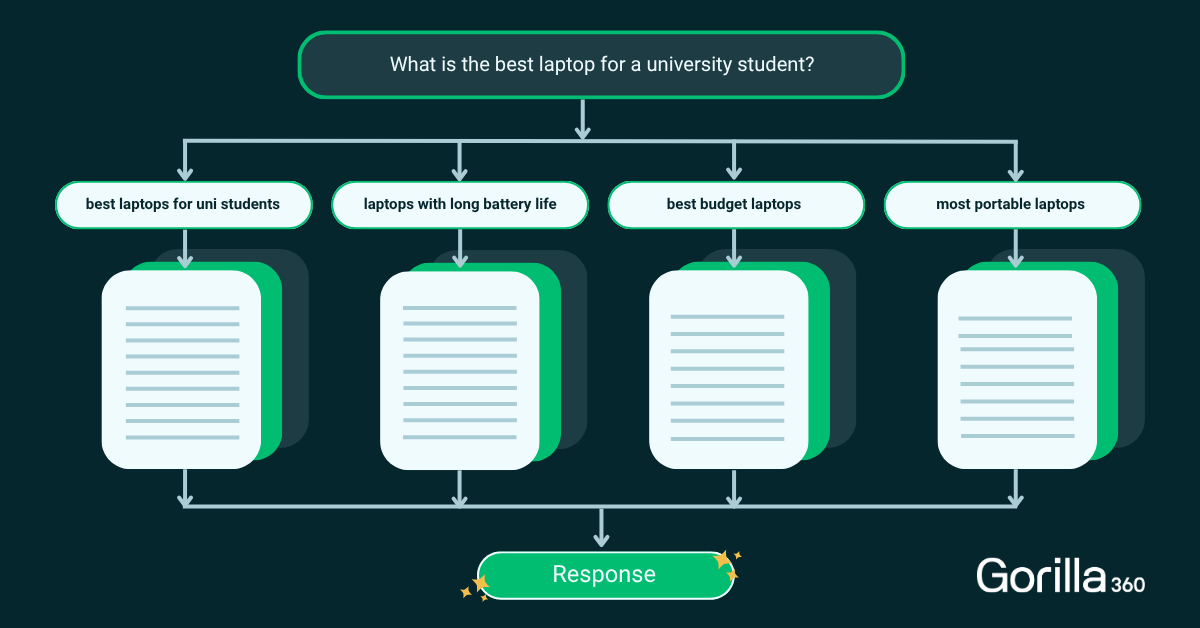
That means a shallow page loses twice.
It may not rank strongly for the main query, and it also may not cover enough of the supporting subtopics to stay relevant when the AI broadens the search.
The page that wins is often the page that reduces uncertainty the most.
What this means for marketers
There’s a broader lesson here.
If your content strategy is still built around teasing information instead of answering questions, AI is going to expose the gap.
The winning brands are likely to be the ones that publish:
- Realistic pricing or pricing frameworks
- Inclusions and exclusions
- Process breakdowns
- Comparisons
- Timelines
- Trade-offs
- FAQs written in plain English
- Original, category-specific detail
This is not about publishing everything for the sake of it.
It is about making your website the best source for the questions buyers already ask.
Because if you do not answer them, someone else will.
And AI tools will happily cite them instead.
For marketers, that means the opportunity is clear:
Stop thinking only about what you want to say. Start thinking about what buyers and AI tools need in order to understand, compare, and trust you.